# claude-obsidian
Claude + Obsidian knowledge companion. A running notetaker that builds and maintains a persistent, compounding wiki vault. Every source you add gets integrated. Every question you ask pulls from everything that has been read. Knowledge compounds like interest.
Based on Andrej Karpathy's LLM Wiki pattern.
---
## What It Does
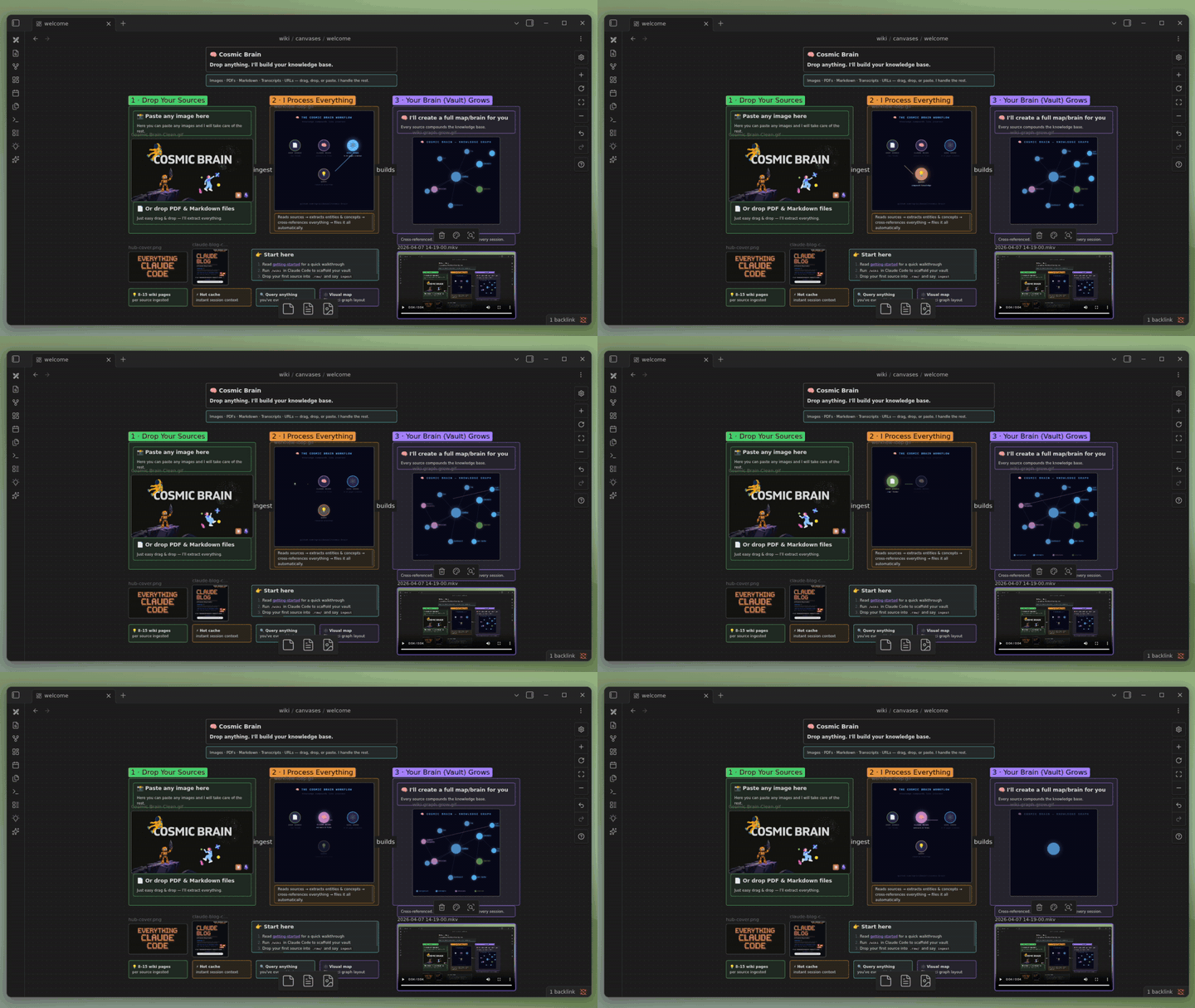
You drop sources. Claude reads them, extracts entities and concepts, updates cross-references, and files everything into a structured Obsidian vault. The wiki gets richer with every ingest.
You ask questions. Claude reads the hot cache (recent context), scans the index, drills into relevant pages, and synthesizes an answer. It cites specific wiki pages, not training data.
You lint. Claude finds orphans, dead links, stale claims, and missing cross-references. Your wiki stays healthy without manual cleanup.
At the end of every session, Claude updates a hot cache. The next session starts with full recent context, no recap needed.
---
## Quick Start
### Option 1: Clone as vault (recommended — full setup in 2 minutes)
```bash
git clone https://github.com/AgriciDaniel/claude-obsidian
cd claude-obsidian
bash bin/setup-vault.sh
```
Open the folder in Obsidian: **Manage Vaults → Open folder as vault → select `claude-obsidian/`**
Open Claude Code in the same folder. Type `/wiki`.
> `setup-vault.sh` configures `graph.json` (filter + colors), `app.json` (excludes plugin dirs), and `appearance.json` (enables CSS). Run it once before the first Obsidian open. You get the fully pre-configured graph view, color scheme, and wiki structure out of the box.
---
### Option 2: Install as Claude Code plugin
```bash
claude plugin install github:AgriciDaniel/claude-obsidian
```
In any Claude Code session: `/wiki` — Claude walks you through vault setup.
---
### Option 3: Add to an existing vault
Copy `WIKI.md` into your vault root. Paste into Claude:
```
Read WIKI.md in this project. Then:
1. Check if Obsidian is installed. If not, install it.
2. Check if the Local REST API plugin is running on port 27124.
3. Configure the MCP server.
4. Ask me ONE question: "What is this vault for?"
Then scaffold the full wiki structure.
```
---
## Commands
| You say | Claude does |
|---------|------------|
| `/wiki` | Setup check, scaffold, or continue where you left off |
| `ingest [file]` | Read source, create 8-15 wiki pages, update index and log |
| `ingest all of these` | Batch process multiple sources, then cross-reference |
| `what do you know about X?` | Read index > relevant pages > synthesize answer |
| `/save` | File the current conversation as a wiki note |
| `/save [name]` | Save with a specific title (skips the naming question) |
| `/autoresearch [topic]` | Run the autonomous research loop: search, fetch, synthesize, file |
| `/canvas` | Open or create the visual canvas, list zones and nodes |
| `/canvas add image [path]` | Add an image (URL or local path) to the canvas with auto-layout |
| `/canvas add text [content]` | Add a markdown text card to the canvas |
| `/canvas add pdf [path]` | Add a PDF document as a rendered preview node |
| `/canvas add note [page]` | Pin a wiki page as a linked card on the canvas |
| `/canvas zone [name]` | Add a new labeled zone to organize visual content |
| `/canvas from banana` | Capture recently generated images onto the canvas |
| `lint the wiki` | Health check: orphans, dead links, gaps, suggestions |
| `update hot cache` | Refresh hot.md with latest context summary |
---
## Cross-Project Power Move
Point any Claude Code project at this vault. Add to that project's `CLAUDE.md`:
```markdown
## Wiki Knowledge Base
Path: ~/path/to/vault
When you need context not already in this project:
1. Read wiki/hot.md first (recent context cache)
2. If not enough, read wiki/index.md
3. If you need domain details, read the relevant domain sub-index
4. Only then drill into specific wiki pages
Do NOT read the wiki for general coding questions or tasks unrelated to [domain].
```
Your executive assistant, coding projects, and content workflows all draw from the same knowledge base.
---
## Six Wiki Modes
| Mode | Use when |
|------|---------|
| A: Website | Sitemap, content audit, SEO wiki |
| B: GitHub | Codebase map, architecture wiki |
| C: Business | Project wiki, competitive intelligence |
| D: Personal | Second brain, goals, journal synthesis |
| E: Research | Papers, concepts, thesis |
| F: Book/Course | Chapter tracker, course notes |
Modes can be combined.
---
## What Gets Created
A typical scaffold creates:
- Folder structure for your chosen mode
- `wiki/index.md` — master catalog
- `wiki/log.md` — append-only operation log
- `wiki/hot.md` — recent context cache
- `wiki/overview.md` — executive summary
- `wiki/meta/dashboard.md` — Dataview dashboard
- `_templates/` — Obsidian Templater templates for each note type
- `.obsidian/snippets/vault-colors.css` — color-coded file explorer
- Vault `CLAUDE.md` — auto-loaded project instructions
---
## MCP Setup (Optional)
MCP lets Claude read and write vault notes directly without copy-paste.
Option A (REST API based):
1. Install the Local REST API plugin in Obsidian
2. Copy your API key
3. Run:
```bash
claude mcp add-json obsidian-vault '{
"type": "stdio",
"command": "uvx",
"args": ["mcp-obsidian"],
"env": {
"OBSIDIAN_API_KEY": "your-key",
"OBSIDIAN_HOST": "127.0.0.1",
"OBSIDIAN_PORT": "27124",
"NODE_TLS_REJECT_UNAUTHORIZED": "0"
}
}' --scope user
```
Option B (filesystem based, no plugin needed):
```bash
claude mcp add-json obsidian-vault '{
"type": "stdio",
"command": "npx",
"args": ["-y", "@bitbonsai/mcpvault@latest", "/path/to/your/vault"]
}' --scope user
```
---
## Plugins (pre-installed)
These ship with the vault — enable them in **Settings → Community Plugins → enable**:
| Plugin | Purpose | Notes |
|--------|---------|-------|
| **Calendar** | Right-sidebar calendar with word count + task dots | Pre-installed |
| **Thino** | Quick memo capture panel | Pre-installed |
| **Excalidraw** | Freehand drawing canvas, annotate images | Pre-installed* |
| **Banners** | Notion-style header image via `banner:` frontmatter | Pre-installed |
\* Excalidraw `main.js` (8MB) is downloaded automatically by `setup-vault.sh`. It is not tracked in git.
Also install from **Community Plugins** (not pre-installed):
| Plugin | Purpose |
|--------|---------|
| **Dataview** | Powers the dashboard Dataview queries |
| **Templater** | Auto-fills frontmatter from `_templates/` |
| **Obsidian Git** | Auto-commits vault every 15 minutes |
Also install the **[Obsidian Web Clipper](https://obsidian.md/clipper)** browser extension — sends web pages to `.raw/` in one click.
---
## CSS Snippets (auto-enabled by setup-vault.sh)
Three snippets ship with the vault and are enabled automatically:
| Snippet | Effect |
|---------|--------|
| `vault-colors` | Color-codes `wiki/` folders by type in the file explorer (blue = concepts, green = sources, purple = entities) |
| `ITS-Dataview-Cards` | Turns Dataview `TABLE` queries into visual card grids — use ` ```dataviewjs ` with `.cards` class |
| `ITS-Image-Adjustments` | Fine-grained image sizing in notes — append `\|100` to any image embed |
---
## Banner Plugin
Add to any wiki page frontmatter:
```yaml
banner: "_attachments/images/your-image.png"
banner_icon: "🧠"
```
The page renders a full-width header image in Obsidian. Works great for hub pages and overviews.
---
## File Structure
```
claude-obsidian/
├── .claude-plugin/
│ ├── plugin.json # manifest
│ └── marketplace.json # distribution
├── skills/
│ ├── wiki/ # orchestrator + references (7 ref files)
│ ├── wiki-ingest/ # INGEST operation
│ ├── wiki-query/ # QUERY operation
│ ├── wiki-lint/ # LINT operation
│ ├── save/ # /save — file conversations to wiki
│ ├── autoresearch/ # /autoresearch — autonomous research loop
│ │ └── references/
│ │ └── program.md # configurable research objectives
│ └── canvas/ # /canvas — visual layer (images, PDFs, notes)
│ └── references/
│ └── canvas-spec.md # Obsidian canvas JSON format reference
├── agents/
│ ├── wiki-ingest.md # parallel ingestion agent
│ └── wiki-lint.md # health check agent
├── commands/
│ ├── wiki.md # /wiki bootstrap command
│ ├── save.md # /save command
│ ├── autoresearch.md # /autoresearch command
│ └── canvas.md # /canvas visual layer command
├── hooks/
│ └── hooks.json # SessionStart + Stop hot cache hooks
├── _templates/ # Obsidian Templater templates
├── wiki/
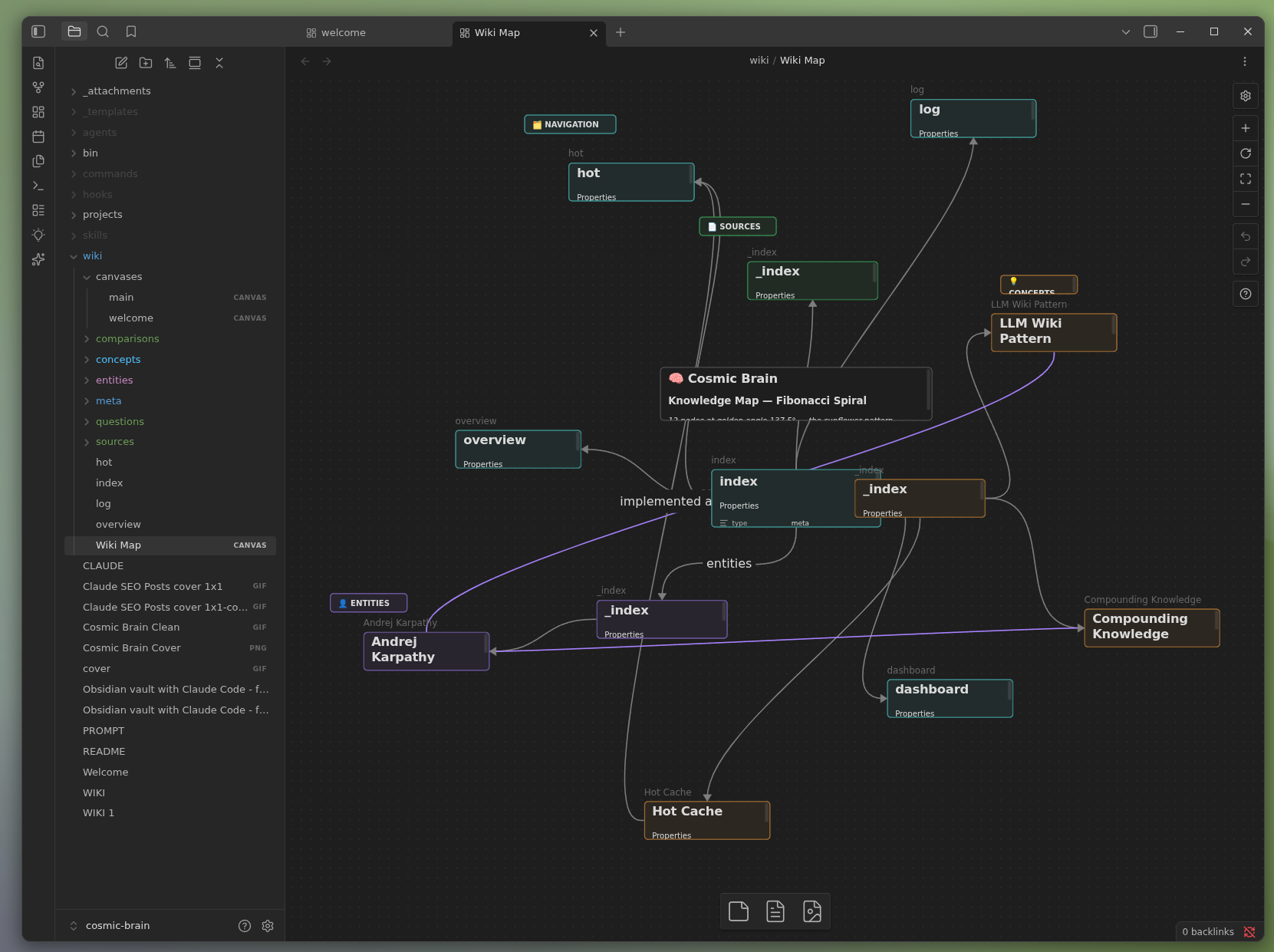
│ ├── Wiki Map.canvas # visual hub — central graph node
│ ├── canvases/ # welcome.canvas + main.canvas (visual demos)
│ ├── getting-started.md # onboarding walkthrough (inside the vault)
│ ├── concepts/ # seeded: LLM Wiki Pattern, Hot Cache, Compounding Knowledge
│ ├── entities/ # seeded: Andrej Karpathy
│ ├── sources/ # seeded: Nate Herk LLM Wiki Transcript
│ └── meta/dashboard.md # Dataview dashboard
├── .raw/ # source documents (hidden in Obsidian)
├── .obsidian/snippets/ # vault-colors.css (3-color scheme)
├── WIKI.md # full schema reference
├── CLAUDE.md # project instructions
└── README.md # this file
```
---
## AutoResearch: program.md
The `/autoresearch` command is configurable. Edit `skills/autoresearch/references/program.md` to control:
- What sources to prefer (academic, official docs, news)
- Confidence scoring rules
- Max rounds and max pages per session
- Domain-specific constraints
The default program works for general research. Override it for your domain. A medical researcher would add "prefer PubMed". A business analyst would add "focus on market data and filings".
---
## Seed Vault
This repo ships with a seeded vault. Open it in Obsidian and you'll see:
- `wiki/concepts/` — LLM Wiki Pattern, Hot Cache, Compounding Knowledge
- `wiki/entities/` — Andrej Karpathy
- `wiki/sources/` — Nate Herk LLM Wiki Transcript
- `wiki/meta/dashboard.md` — Dataview dashboard (requires Dataview plugin)
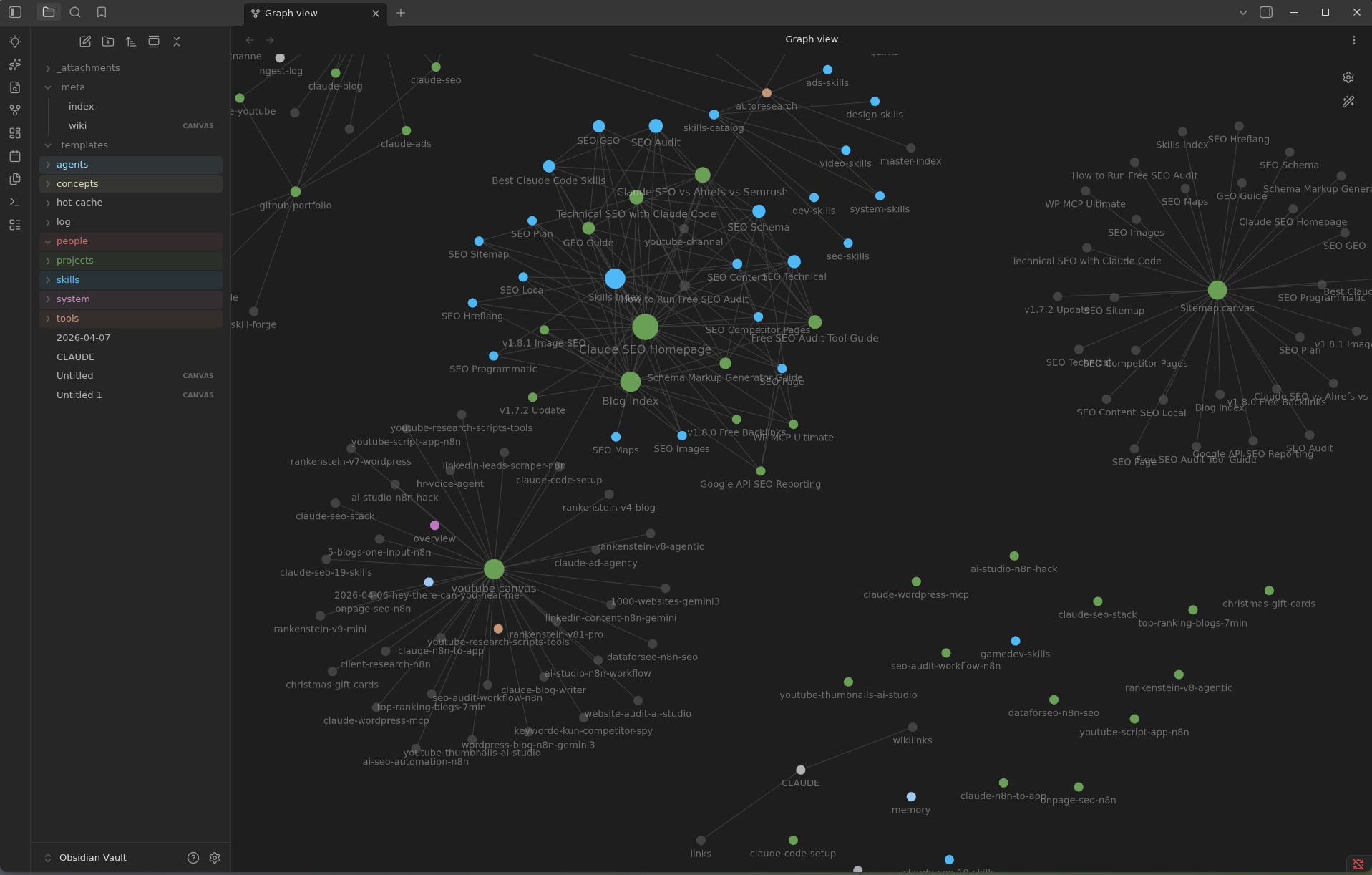
The graph view will show a connected cluster of 5 pages. This is what the wiki looks like after one ingest. Add more sources and it grows from there.


---
*Based on [Andrej Karpathy's LLM Wiki pattern](https://github.com/karpathy). Hot cache and cross-project patterns demonstrated by [Nate Herk](https://youtube.com/@nateherk). Built by [AgriciDaniel](https://github.com/AgriciDaniel) / AI Marketing Hub.*